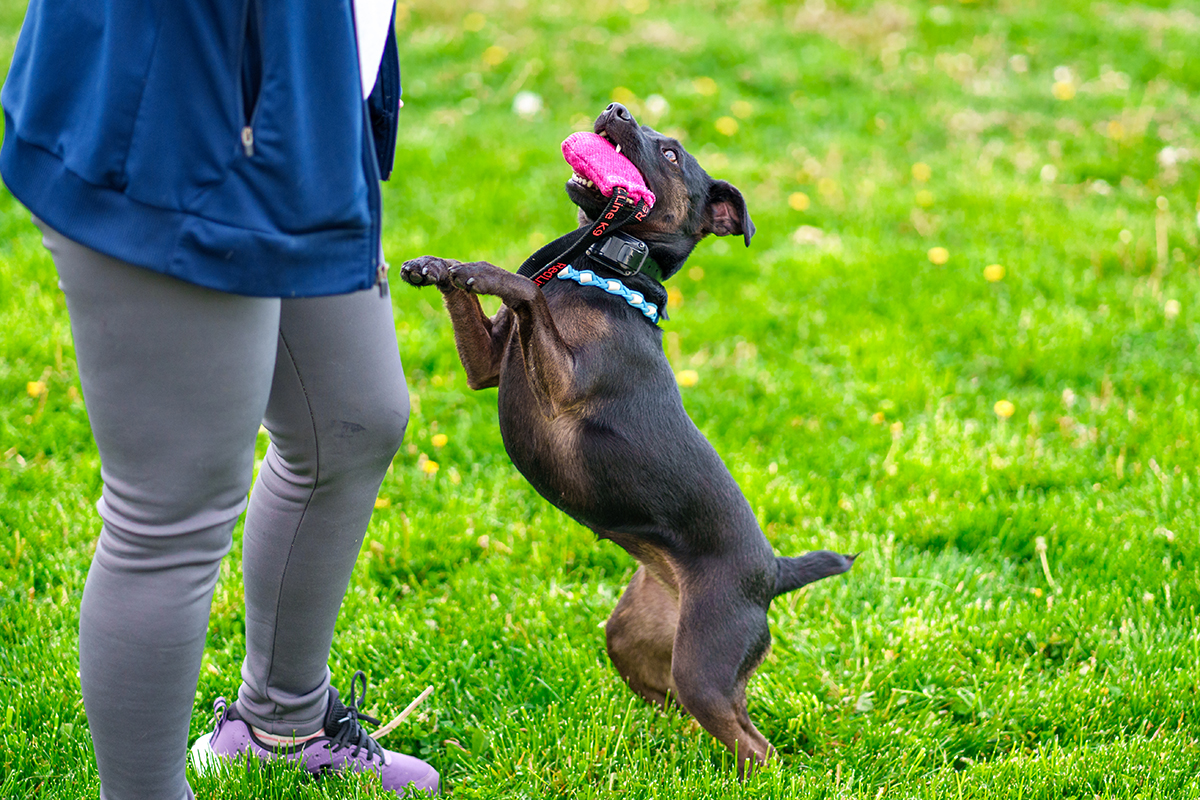
Do you want to reset your dogs behaviour? Do you want to build a better relationship with your dog? Do you want to increase your dogs vocabulary and skills? Do you want to avoid paying thousands of dollars for a board and train to do so? You can do all of this yourself, at home, with some guidance, dedication to consistency, willingness to look inward to see what needs changing from your end and looking to your dog to make sure that you are properly fulfilling their needs for breed/temperament type.
In this post I have put together a simple way to start, with some easy to follow guidance and loose schedules. Dog training isn’t rocket science but it absolutely requires patience, consistency, dedication and self reflection. As well, I do recommend investing in a Starmark Collar (plastic prong) or a Halti/Gentle Leader at bare minimum in order to gain leverage and communication where needed. I hope this information helps you get on the path to building the dog that you’ve always dreamed of having.
We are going to call this “The Great Reset Your Dog Challenge”. Anyone can join this challenge. I have no prizes or money to give out at the end, but what I can offer is a better, more symbiotic relationship with your dog. If you would like to update us on your progress if you decide to join this challenge, we’d be ecstatic to hear it. So enough chit chat, we’re going to get right into it.
Week One Reset Challenge:
No obedience, no specific behaviours, just the following easy to do items.
Day 1-7 – Ignore your dog. This doesn’t mean that you don’t exercise or play with them, but it does mean in between these times, we are going to make you more important to pay attention to and become more valuable by not giving away your attention, time, touch and verbal encouragement for free. Your dog is a foot stool who still needs walks, let outs and play.
Day 1-7 – Enforced separation or crate time. Include scheduled crate times daily – preferably three times a day, an hour or two each time.
Day 1-7 – Drag line on in the house, no exceptions (supervised only and not in the crate). If that drag line needs to be attached to you, so be it.
Day 1-7 – Use leash to enforce rules and crate if/where needed for separation on top of scheduled crate time.
Day 1-7 – One good half hour to 45 minute walk a day along with scheduled play time which may include tug, fetch or find it (not snuffle mats or puzzle games, but actually teaching the dog how to search for food or toy). Another 15 – 20 minute walk on top of this would be a great added bonus.
Day 1-7 – Once or Twice a week of a long line/flexi leash decompression/sniff walk if able to in a safe location.
The hardest part of day 1-7 will be ignoring your dog. However, this is an absolutely crucial step to take in order to reset behaviour and make you into someone who is important to listen to.
Week Two Reset Challenge:
We are going to incorporate some training into this schedule along with all of the above from week one.
Day 8-15 – Morning – 2-10 minutes of getting reps in of sits, downs, place and recall. Time will depend on age and drives. Always leave your dog wanting more, not less. Easy to use meal time for this – then there is no excuses.
Day 8-15 – Afternoon – if you are not stuck at work, another 2-10 minutes of reps or a 30 minute walk which includes working on loose leash skills. This may mean you don’t travel very far for the first little while. Your goal is no leash pulling, not to get around the neighbourhood, so reduce distance, not time. Work on properly coming out front door, off porch, down driveway, a few houses down and back, expanding distance as understanding grows.
Day 8-15 – Evening – 2-10 minutes of getting reps in of sits, downs, place and recall. Easy to use meal time for this – once again, no excuses.
Day 8-15 – Evening – another 15-20 minute walk/loose leash session or a 30-45 minute walk including the same work as the afternoon walk.
Week Three Reset Challenge:
Day 16-22 – We will be increasing complexity of sits, downs, place and recall. This means adding distraction and duration to the behaviours. Remember drag line is still on the dog, and should be used to help enforce what is being asked. 2- 10 minutes of rep practice. AND continue all from week 1 and 2. DO NOT forget the play (tug, fetch or find it) and decompression walks, they are very important for your dog.
Day 16-22 – Meal times are great training time for reps, but now we need to sprinkle what has been learned into real life – sit before eating or going outside, down while we watch a movie, place while we eat meals etc. Incorporate these behaviors learned into real life scenarios. Be sure to remain fair to your dog and don’t expect miracles if you haven’t practiced for miracles.
Day 16-22 – Incorporate long line recalls into decompression/sniff walks every now and then.
Day 16-22 – Work on impulse control – leave its, outs, waits – do this once or twice a day within a game or training time with reps.
Week Four Reset Challenge:
Evaluate your dogs behaviour and see if there are any sticking points that need work. Address those and practice as needed.
This reset isn’t a one and done though. Training happens every minute of every day when your dog is awake. That doesn’t mean it has to be exhausting, that means you have to be mindful of what you are allowing, what you are rewarding, what you are correcting, where your attention goes and what is the dog getting out of all these things.
This is the time to really look inward.
What are you doing to contribute to behaviours that you don’t like? Are you constantly pushing energy towards your dog? Does your dog know how to push your buttons? Is your dog taking your attention (either negative or positive) as reward when you don’t want them to? Are you anxious, nervous, angry, frustrated when working with your dog? Why? Is your communication clear, or are you adding long drawn out explanations and corrections? Are you rewarding enough? Do you cater to your dogs every desire or whim? Do you jump when your dog says jump?
Your inner conflicts, energy and mentality have a massive effect on your dogs behaviour.
This is very similar to how your the same affects your children. If you want to change your dog, you need to be willing to change yourself and your habits, this isn’t a one end of the leash type thing. Of course, there are some exceptions with really messed up dogs, aggression and extreme fear, but most failed training and behaviour work involves the unwillingness of people to put in the work and change their habits. Journal, write down where you might be going wrong, your moods, your energy, note patterns. Having these things written down makes them easier to address going forward.
Good luck! And here’s to enjoying a more relaxed, confident, fulfilled and happy relationship with your dog!
*Would you like a PDF file of this write up to print? Please contact us and we’d be happy to provide that.
 Smart Dogs Canine Training Milton